
The Power We're Learning to Hold
What a stadium concert revealed about collective intelligence

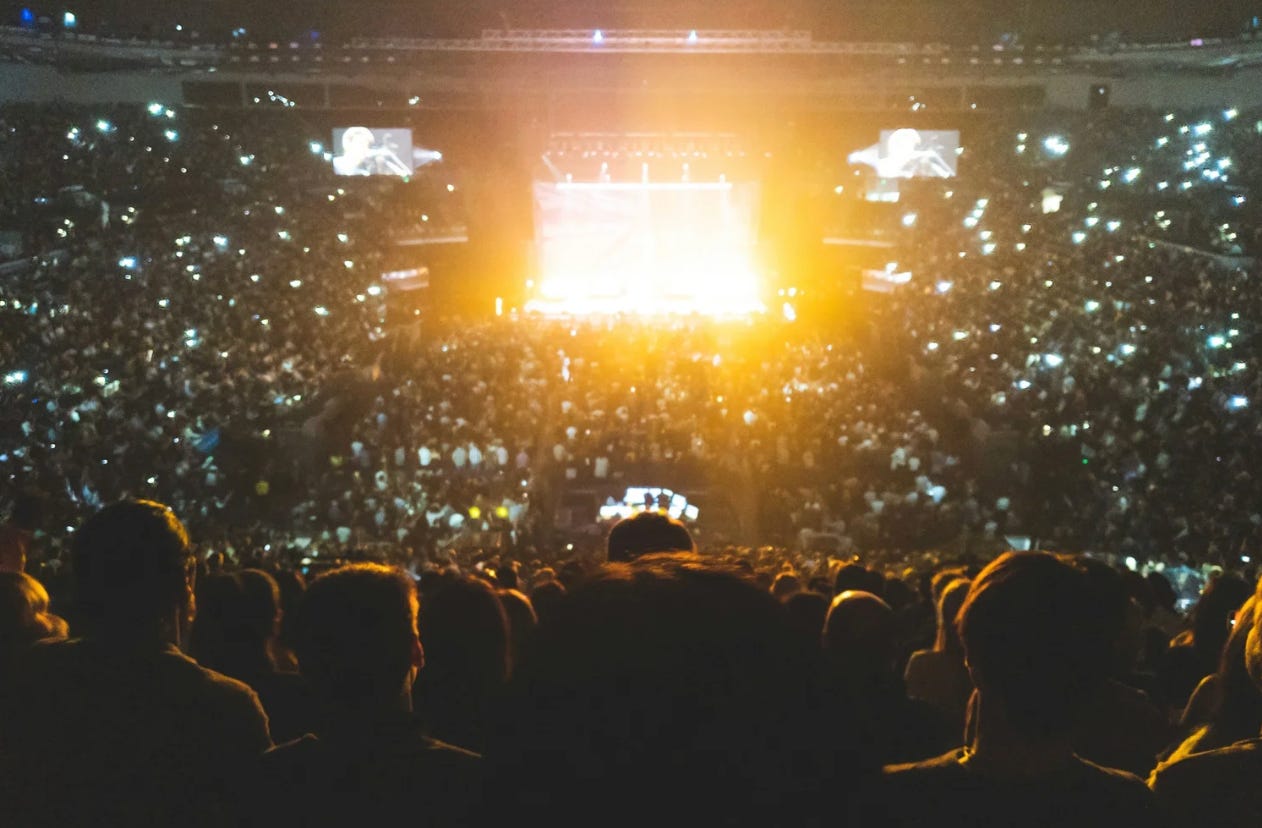
It was in the fall of 1988 that I went to my first benefit concert. I remember standing on the field of the stadium where I’d watched countless baseball games as a kid, looking up at a large banner next to the stage that read Human Rights Now! The sun had gone down and the temperature was dropping fast, but spirits were high. I stood there in the cold, insulated by my friends and the crowd around us, unsure who might play next. Sting was in the lineup but there were rumors floating around that he might not show.
The crowd began to settle, and then a woman walked out on stage with an acoustic guitar. She started playing a familiar melody I’d been hearing on the radio. Her first notes filled the air with a charge I didn’t have words for, and the whole stadium seemed to vibrate with it.
Don’t you know
they’re talkin’ bout a revolution
It sounds like a whisper
Tracy Chapman’s voice cut through the cool night air like truth rising from the earth. It carried sadness, grief, and hope all at once, and moved through me in a way that felt both intimate and immense.
There was something powerful about being there with thousands of strangers, all gathered for a cause bigger than any of us. A sense of possibility hung in the air—people of all ages believing, or wanting to believe, that music and solidarity could shift something in the world. That our presence mattered. That our bodies, our togetherness, could somehow contribute to change.
Benefit concerts had that ability back then to gather people around an idea, if only for a night.
When Tracy Chapman sang “Talkin’ Bout a Revolution,” it felt like an invitation. A reminder that real change often begins quietly, like a whisper spreading through a crowd before anyone realizes something has shifted.
Looking back, I can feel just how real the power of that night was, how it lifted all of us—the charge, the openness, the sense of possibility. And I can also feel the limits of the model. We were gathered for a good cause, but the structure wasn’t built to last. A night like that could stir something real, but it couldn’t contain what it awakened. The energy rose, moved through the crowd, and then faded into the night.
I’m struck by how much collective strength we actually had in that moment without realizing it. We were thousands of bodies, relationships, and shared intentions gathered in one place, pooling our money, attention, and hope. All that energy, all that possibility, right there in the crowd… with nowhere for it to go. It simply didn’t occur to me that what we were experiencing shoulder to shoulder might be its own kind of power—something that could live beyond a single evening if we had somewhere to put it.
That night taught me that moments alone aren’t enough. We also need structures that don’t disappear when the event ends, whether it’s a concert, a protest, or an experience of collective inspiration. Systems that can hold the energy of ordinary people and give real change a place to live.
Still, that experience planted something in me (and in thousands of others). Events like these matter. They awaken us, show us what’s possible, introduce us to ideas and people we might never have encountered otherwise. They’re the spark. I just didn’t yet have the understanding or tools to build what the energy of that evening was pointing toward.
Our nervous systems are always participating in the structures around us.
When people feel safe with one another, their nervous systems shift. They can think more clearly, take risks, imagine new possibilities, and support each other in ways that aren’t available in isolation. Co-regulation becomes collaboration, and collaboration becomes momentum. And momentum, when held inside the right structure, can become a kind of collective intelligence stronger than anything a single event can produce.
I think of the mutual aid networks that formed during the pandemic—neighbors organizing grocery deliveries, dropping off meals, checking in on each other week after week. These aren’t dramatic or loud. They’re structures sustained by shared effort, splitting resources, and ongoing care. They don’t depend on a stage or a spotlight. They depend on people learning to carry something together over time, building the capacity to hold each other through more than just one moment of crisis or inspiration.
When I think back to that night (the cold air, the banner, the strangers standing together), I can see that there was more happening in that stadium than just the magic on the stage. In the crowd, in the way our bodies were responding to one another, we were our own force. Most of us didn’t yet have language for shared power or community-based systems. Those ideas existed in certain movements, but they hadn’t entered the wider culture. We felt something rising in us, but we didn’t know how to carry it forward or build it into something lasting. We only knew how to feel it for a brief time and then let it go.
What I’m discovering is that when people have a way to pool their power, something different becomes possible. The energy doesn’t just rise and disappear; it can settle, weave, and take shape over time. But this requires a different way of seeing than most of us were taught, which was to look upwards to leaders, stages, and institutions. The truth is, real power has always lived horizontally in the ways people share resources, care for each other, and show up even when no one is watching. It’s a different kind of strength, one that is distributed, grounded, and built from the inside out.
Now I find myself working with others to build something that could sustain that. A system for people to circulate resources, develop trust through reciprocity, and create lasting infrastructure for the kind of change that night hinted at. I’m learning what it actually takes to build a container strong enough for collective power.
And this work is happening everywhere. More of us are learning to build ways of organizing that can hold what our bodies have always sensed: that power lives in the relationships between us.
Maybe the whisper Tracy Chapman sang about was that real revolution emerges from the small, daily ways people choose each other. The rest (how to give it a home) is what we’re figuring out now.
Substack needs a SUPER like button.
Tracey Chapman ❤️. ‘Insulated by my friends’ gave me a warm squeeze as I read it!