
The Long Unwinding: The Threshold
At the edge of what comes next

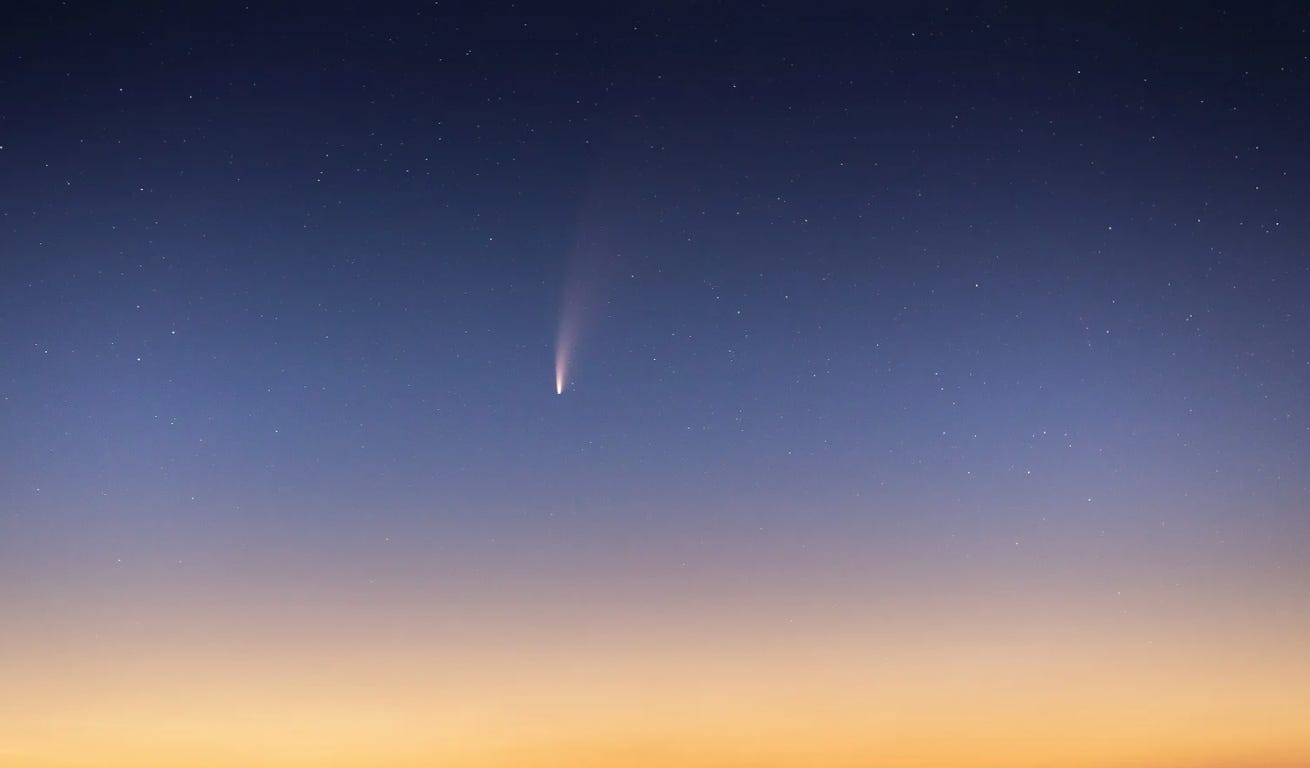
There’s something in the air right now, and I don’t mean metaphorically.
Although, in some ways, it is that too.
An object believed to be a comet, named 3I/ATLAS, is drifting toward us from interstellar space. It poses no apparent threat to Earth, but has stirred curiosity and speculation. Even a well-known physicist has suggested it might be a piece of alien technology, though most scientists maintain it’s a natural comet.
I don’t know if I care what the scientists ultimately decide it is.
The data, the models, or the “confirmed” anything don’t feel especially meaningful.
What I care about is the feeling of this moment and the atmosphere around it.
Because if you listen closely, something in our collective awareness is bracing.
Not for the comet itself, but for something.
Many people I’ve talked to feel it. Online discussions are filled with it.
The sense that we’re all waiting for the other shoe to drop.
We don’t know what it will look like. We have guesses, but we can’t name it exactly. We’re suspended in the pause between breaths, in the stillpoint, waiting for what’s ready to emerge.
It feels like a mix of fear and hope intertwined.
Maybe the comet is just the sky’s way of offering us something to anchor to.
In the United States, this emotional climate feels especially dense.
Everyone knows something is out of balance.
We’re trying to live normal lives inside a system that is unraveling as we watch.
Politics has become theatrics.
The inner workings of capitalism have come into view.
The wealth gap is widening in plain sight.
The economy (insert your own definition of whatever that word even means now) feels like an elaborate story we all keep circling around, like a hot potato no one wants to hold for long.
And the truth is, many of us feel this not just intellectually, but viscerally.
Yuri Gagarin, the first human in space, once said:
Orbiting Earth in the spaceship, I saw how beautiful our planet is. Let us preserve and increase this beauty, not destroy it.
That’s the thing—when you step outside the system and get a wider view, even for a moment, the illusion of it all becomes clear. The construct we treat as reality doesn’t match the truth on the ground. Or rather, the truth from above.
We are suspended between the world we made and the world we know is possible.
And then, into this moment, a visitor appears in the sky.
For some people, the comet is terrifying.
Others find it exhilarating.
Many may not admit that they actually want it to be something more than ice, rock, and dust moving through space.
Not out of a wish for disaster or a visit from aliens (though some might), but for perspective.
After returning from his time on the International Space Station, former astronaut Ron Garan said:
I saw the unbelievable thinness of our planet’s atmosphere. In that moment, I was hit with the sobering realization that that paper-thin layer keeps every living thing on our planet alive.
And then:
I saw an iridescent biosphere teeming with life. I didn’t see the economy. But since our human-made systems treat everything, including the very life-support systems of our planet, as the wholly owned subsidiary of the global economy, it’s obvious from the vantage point of space that we’re living a lie.
It speaks to a deeper human longing. A longing to see clearly, to step outside the trance of the systems we’ve built, even for one breath. To glimpse the truth that lies beyond the story we’ve all learned to play along with.
3I/ATLAS becomes a mirror for all of our unspoken longings:
“I hope it destroys everything.”
“I hope it saves us.”
“I hope it’s a sign.”
“I hope it’s aliens.”
“I hope it’s nothing.”
“I hope it’s something.”
Dread and wonder mixed together.
Apocalypse and relief holding hands.
And if I’m honest, I can feel the pull of it too.
Maybe this is why I’ve loved apocalyptic science fiction my entire life.
Arrival is my favorite movie.
Interstellar is a close second.
When I heard people rave about Sunshine, a movie I’ve never seen but felt immediately drawn to, I got really excited.
Those stories aren’t about disaster, are they?
They’re about contact. (And that reminds me, Contact is also on my list of favorites).
Awareness.
The reminder that we are temporary and interconnected and held by something vast.
Stories that take us to the edge of what it means to be human, and ask what we’ll become next.
Garan spoke to this too. He described the grief that cracked him open when he saw Earth from above:
It was among the strongest feelings of grief I have ever encountered… the extinction of species, flora, fauna… things that took five billion years to evolve, and suddenly we will never see them again because of the interference of mankind.
It’s devastating.
And clarifying.
That’s what this moment feels like: devastating and clarifying, all at once.
We don’t know what we’re waiting for.
What’s coming is a mystery.
Will the change we need arrive through collapse, contact, revelation, awakening—or through the slow, collective work of creating something new?
The threshold of change is here.
We’re already inside it.
Some people are trying their best to live life one day at a time, putting one foot in front of the other.
Others are barely getting by.
Many are carrying more than they have capacity for.
In that kind of atmosphere, a comet, a visitor from another system, can feel like a reminder, or a threat, or a promise.
The meaning isn’t in the comet itself, but in what it reveals about us.
We know, deep in our bones, that we cannot continue as we are.
And we long for clarity, ache for connection, quietly hoping the sky will show us something we’ve forgotten.
We’re not just waiting for the other shoe to drop.
Some part of us wants to be shaken awake.
Garan said something that feels like the pulse beneath this moment:
When we can evolve beyond a two-dimensional us-versus-them mindset and embrace the true multi-dimensional reality of the universe… that’s when we’re going to no longer be floating in darkness… and it’s a future that we would all want to be part of. That’s our true calling.
Maybe the comet won’t change anything.
Or maybe it already has.
Because it’s gotten us to look up.
And sometimes, that’s all a moment needs.
Just the act of remembering that the sky is still there,
and that we’ve been living under it this whole time.
This is Part 4 of my ongoing series, The Long Unwinding, reflections on this collective moment of unraveling, remembering, and becoming.
You can read the earlier parts here: Part 1: The Long Unwinding, Part 2: The Relief of Collapse, and Part 3: In the Stillpoint.
Beautifully said, April.
Truly a thin line between Heaven and Earth. Something has to give, and we all feel it, and some pretend not to see. I care, and I know you do too.