
Circle vs. Pyramid Culture
On systems, hierarchy, and returning to what we already know


I was sitting in 9th grade Advanced English when Mr. G announced he’d be reading our poems aloud.
When he got to mine, he paused. He squinted at it and his face tightened. He read it anyway, and when he finished, he looked up and said:
“Okkkaaaayyy?”
The kind of okay that meant: What the hell was that?
The kind that told me: You did it wrong.
We’d been studying poetry in a very formulaic way. There were clear rules. A “right” way. But something in me couldn’t follow them.
I was new to poetry. But I wasn’t new to expression. So I wrote something true. Something that was uniquely mine.
At the end of class, Mr. G pulled me aside.
“You don’t belong in Advanced English,” he said. “I’m going to demote you.”
That was the moment I learned what happens when you speak in a voice the system doesn’t recognize.
The classroom had a very specific form. It was hierarchical. Authoritative. Structured to reward the students who followed instructions, stayed inside the lines, and produced the right answers.
It was a clear example of what I now understand as pyramid culture: a way of organizing systems where power flows from the top, and everyone else is expected to fall in line. It rewards performance, hierarchy, and control.
I wasn’t one of those students.
Whenever I found myself in those settings, it felt like a test—not just of knowledge, but of worth. There was an unspoken pressure to prove value based on how much information you could hold in your head and how quickly you could recall it. I was afraid of getting it wrong and being judged. I felt the pressure to perform, and to think in a linear, logical way.
But that’s never been how I process the world.
I’m a big-picture, systems thinker. I track patterns and sense what’s happening beneath the surface. In class, I often found myself observing power dynamics, how people interacted, and what wasn’t being said. I wanted to learn, but I wanted to do it through experience, relationship, and what was unfolding in real time. I didn’t want to focus on memorizing facts that had little meaning to me. I wanted to understand.
I sat in the middle aisle, literally and figuratively. I wasn’t white, and I wasn’t Black. I was Asian. I didn’t belong to either group. I observed how each group behaved, how they treated each other, and how they treated me. I noticed things that didn’t get talked about. And I stayed mostly quiet.
Not because I didn’t have anything to say. But because I could feel the rules. I could feel what the structure required in order to succeed. To belong. And I knew that telling the truth—my truth—wasn’t safe there.
My nervous system learned to adapt. Staying quiet wasn’t just a choice, it was protection. In a space where performance was prized over presence, silence became a way to stay safe.
The classroom felt rigid and confined. There was one kind of intelligence that mattered: linguistic-mathematical. Everything else: emotional knowing, somatic awareness, intuition—lived outside the frame.
It was a top-down model of knowledge. The teacher was the authority. The students were there to absorb what was given. The underlying message was clear: I know what’s best for you.
But even then, I sensed something different. I knew that authority didn’t automatically mean wisdom. I could feel that intelligence didn’t just live in the mind. It also lived in the body, in the emotions, in our relationships with each other. I knew that every person carried a kind of knowing that couldn’t always be measured or explained.
I didn’t know how to name that at the time. And it didn’t feel safe to speak it out loud. But I never stopped listening to it.
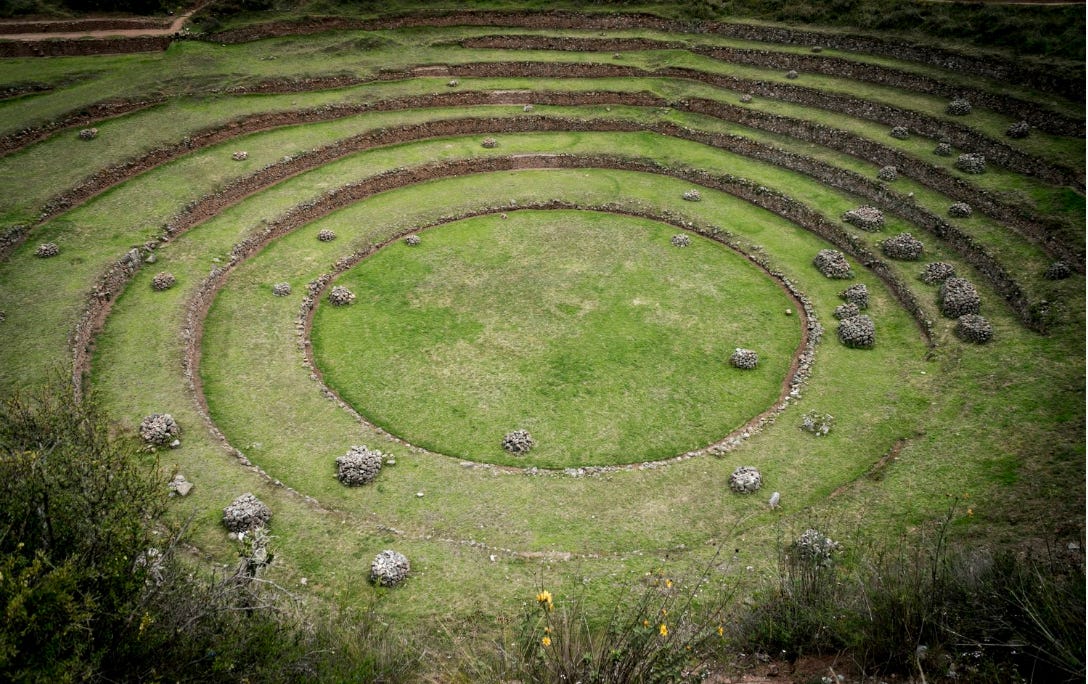
It wasn’t until much later that I found a name for what I’d always felt: circle culture.
Circle culture is relational, inclusive, and nonlinear. It’s not about controlling outcomes or rising to the top. It’s about connection, presence, and shared power. In a circle, everyone belongs. Each person brings a piece of the whole. No one has to fight for visibility or authority. There’s space for truth to emerge and not be controlled.
I felt this way of being long before I knew how to name it. On the playground, with friends, in certain moments at family gatherings. I wasn’t trying to lead, but I was often the one with the ideas. The one who gathered people, sparked something, created the energy to begin. I didn’t need to control what happened after that. I just held the container long enough for the group to take it from there.
That was facilitation. That was circle. And even then, it felt natural.
I’ve since come to recognize circle culture not just in my own experience, but in many Indigenous traditions. In Hawai‘i, it lives in the way people gather, make decisions, and honor the land. Knowledge isn’t something passed down from a single authority. It arises through relationship, shared experience, and collective wisdom. These are ways of living that reflect a different orientation to power: not imposed from above, but held together.
It’s taken me years to understand that what I sensed back then wasn’t just personal, but foundational. The discomfort I felt in rigid systems wasn’t rebellion for its own sake. It was my body holding onto something I already knew but didn't yet have words for.
Now, in my work, I create spaces that reflect the very qualities I longed for as a child. Whether I’m teaching, guiding, or writing, I hold a field of permission for people to slow down, to feel what’s real, to listen inwardly instead of performing outwardly.
I guide people into presence, where stillness, inner listening, and the wisdom of non-doing can begin to emerge. But these aren’t just tools for healing or self-regulation. They’re also frameworks for how we might live, lead, and create differently.
They reflect a bottom-up way of being: one that honors the intelligence of the body, the moment, the relationship, the whole. In a top-down model, authority flows from above and tries to control the outcome. In a bottom-up model, wisdom arises from within through sensing, responding, and attuning to what’s already here.
And yet, structure plays an essential role. In Craniosacral therapy, for example, we work with both the art and the science. Anatomy, physiology, and technique serve the work when held in partnership with intuition, attunement, deep listening, and responsiveness. This is where the two paradigms can meet. Not in opposition, but in relationship.
Circle culture lives in everything I do now. It’s not a theory to explain. It’s a way of being to return to.
I know I’m not the only one who’s felt this.
A lot of us grew up sensing that something didn’t feel quite right. That we didn’t fully belong in the systems we were told to succeed in. Some of us stayed quiet. Some of us adapted. Some of us learned to perform. But beneath all of that, something deeper remained. Something that couldn’t be measured by grades, titles, or approval.
Many of us remember what it feels like to be part of something real. To be in a space where presence matters more than performance. Where leadership isn’t about control, but about creating space for others to show up fully.
The systems we were raised in weren’t just built on hierarchy, but were shaped by a worldview that separated mind from body, logic from emotion, human from nature. For centuries, dominant systems have taught us to trust only what can be measured, predicted, and controlled. But that’s not the only way of knowing. And it’s not the whole story.
Something else is rising: quieter, more ancient, and deeply connected.
We don’t need to prove ourselves to be part of it. We don’t need to compete or convince. We just need to recognize what we already know. And choose to live from that place.
Not everyone will understand. That’s okay.
Some of us are here to build what comes next.
If you enjoyed this piece, you can support my work by becoming a free or paid subscriber, or by buying me a cup of tea. 🍵🙏🏼
Loved this perspective- this was a great read!
Lots of things resonated, but this phrase mainly- “authority didn’t automatically mean wisdom”
My mom gave me many gifts which I’m grateful for. The freedom to question everything around me was a big one.
My first boss and eventual mentor asked me one day “you must have given your mom a run for her money; can’t you do ANYTHING I ask because I said so?” He said it in a lighthearted manner but with some sincerity.
My mom taught me leadership isn’t top down authority. It’s not all knowing. It’s guidance, trust. It’s accountability but with self awareness and compassion. The right emotion for the right moment.. I strive for this in all aspects of my life and relationships.
I never considered it in all the ways you described… circular in nature. Facilitating, allowing for or clearing space for the people in our worlds. Love this and will continue to consider it more. Thank you.
Thank you for sharing this, it really resonates with me around the shift I see happening at this time. From Patriarchal/Left Brain (hierarchy) to Rematriation/Right brain (circular) ways, even though the patriarchy is kicking and screaming to hold hierarchical power. I’m Native American, so I relate to your perspective. I’ll be restacking and subscribing 😊