
A New Shape of Living
On ancestry, belonging, and imagining a different way forward

This morning at the little neighborhood park where I take my dogs, I struck up a conversation with two young kids, a brother and a sister. They were shifting between English and an Asian language I didn’t recognize. Eventually, their father arrived, and when they all started speaking together, I asked what language it was. “Vietnamese,” he said. I was surprised, because it didn’t sound like the Vietnamese I was used to hearing. I don’t speak any Asian languages, but I can usually tell them apart when they’re spoken.
“We’re from the north,” he explained. “Most of the Vietnamese people in this area are from the south. It’s a different dialect than what people here are used to.”
We chatted for a while. With a kind and friendly demeanor, he told me he had originally come to the US to study engineering at the local university. His wife stays home with their three kids - one in high school, one in middle, one in elementary. I asked if they ever planned to return to Vietnam.
“No,” he said without hesitation. “We like it here.”
I mentioned the political atmosphere, wondering how it felt to them.
“We don’t follow the news too much. Just trying to live a good life.”
His words weren’t dramatic, but something in them unsettled me.
I had been holding this country, this system, in a particular light. But now I was looking at someone who had chosen it. Who had built a life here and was living it without complaint.
And I didn’t know what to do with that.
Something in me shifted. A reorientation. Because something in me couldn’t make the pieces line up the way they used to.
I don’t know why they left Vietnam or what their circumstances were. But I looked at this man, this family, living in a west coast college town on a single income, speaking multiple languages, with access to education, safety, and a quiet neighborhood park.
It was a good life. And yet, I found myself wondering what they had left behind.
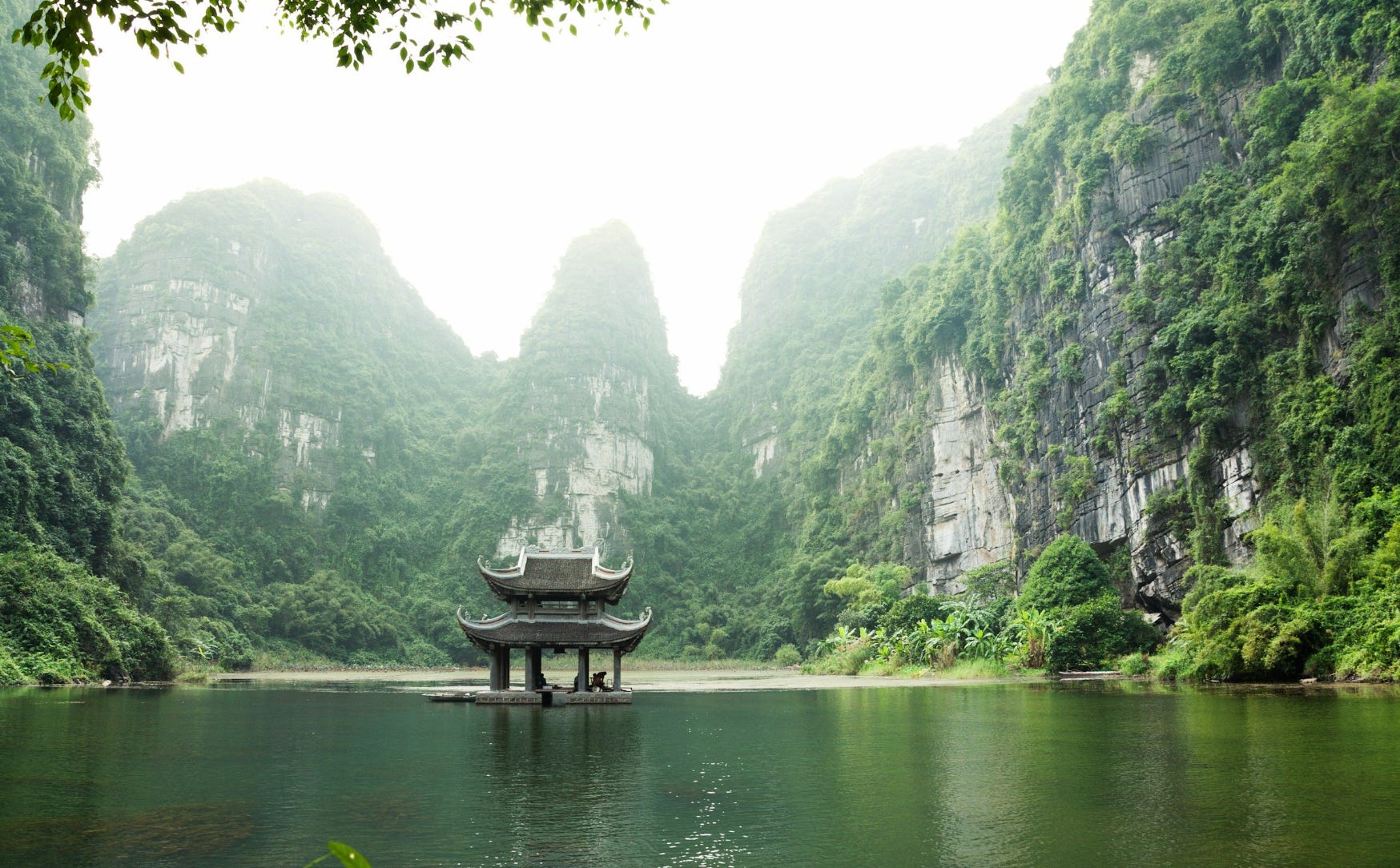
I asked him, if I ever visit Vietnam, where’s one place I shouldn’t miss? He said, “Ninh Binh. That’s where I’m from.”
I looked it up later. Lush green mountains, winding rivers, an absolutely stunning landscape that took my breath away. I found myself thinking: you left this place to live here?
And then, without warning, I found myself thinking about my ancestors. The ones who left China and Japan 160 years ago for North America. The ones who left behind circumstances I may never fully understand. Maybe survival, maybe opportunity, maybe both. But they took a risk. We were just a dream to them at the time. And somehow, the leap they made created the life I now have.
I’ve been angry at them lately. Angry that they left their homeland to come to a place where people like us are invisible, misrepresented, objectified, hyper-visible in some moments and completely erased in others. A place where belonging is conditional and safety is unstable. No, it hasn’t been easy. I’ve experienced trauma, both inherited and personal, and I’ve often felt out of place like I never quite belonged, even in the place I was born. And still, I’ve had so much. I’ve had food, housing, education, and freedom. I’ve had the chance to choose my own path, to ask difficult questions, to imagine a different kind of world. That’s not something everyone is given.
And I’ve also never been satisfied with the world as it is. Never able to fully align with the dominant paradigm. I’ve always questioned. Always carried a curiosity if something else was possible.
And maybe that’s part of my inheritance too.
Not just the privilege, or the survival. But the restlessness. The refusal to fully assimilate into a world that demands so much forgetting. The quiet hunger for a way of life that feels more human, more connected. I’ve spent years exploring circle culture, writing about the ways we’ve traded relational intelligence for hierarchy, presence for productivity, depth for performance. And for a while now, I’ve believed that what’s missing is a way of living that’s more communal, more connected to our shared humanity, and more whole.
Sometimes I wonder what my life would have looked like if I’d been born in a small village in Asia. Maybe I would have waded in rice patties. Or worked in a factory, sewing clothes or assembling electronics. But maybe I would have done that work surrounded by sisters, cousins, and aunties. Women I’d grown up with, making meals, raising children together, living with the seasons. Maybe there wouldn’t have been as many choices, but the pace might have been slower with expectations that were simpler. Life might have felt more cohesive, with a clearer sense of where I belonged.
Of course, that life, too, would have had its risks. Floods, famine, political upheaval, limited mobility. I’ll never know what might have been lost or gained. But even allowing myself to imagine it opened something in me. It helped me see this life with a little more understanding. And for the first time in a while, with a little more thanks.
So the man in the park - this father, this engineer. I don’t know what systems he’s part of or what he believes in, but it didn’t feel like he was pushing an agenda. He seemed like a parent and husband doing his best. A migrant who made a new life. In his presence I felt someone grounded. He wasn’t trying to change the system. He was just living a good life.
I’ve spent a lot of time trying to find another way. I’ve written about it, questioned it, and carried the feeling that something essential has gone missing in how we live now. But what I felt today wasn’t urgency or frustration. It was something deeper. A sense of gratitude I hadn’t expected.
What I keep circling back to is this: the old binaries aren’t working. Not here. Not now. We’re not going back to some ancestral ideal, and we can’t keep living in the isolating hyper-individualism that dominates so much of modern life. Collectivism, in its purest form, doesn’t quite translate in this culture. And capitalism, as it stands, extracts too much from the human spirit and the land itself.
But maybe there’s something in between.
Maybe what we need is not a perfect system, but a living one. One that functions more like an ecosystem: sustained by reciprocity, built by interdependence, and oriented toward relationship rather than output. A way of living where individual purpose is shaped in relation to others, not in isolation. Where responsibility is shared, not offloaded. Where success isn’t measured by domination or performance, but by how well we tend to one another.
Maybe we don’t need to go back or burn it all down.
Maybe we need to compost what’s no longer working and begin to cultivate something different.
Not a circle. Not a pyramid.
Something more like a field.
If you enjoyed this piece, you can support my work by becoming a free or paid subscriber, or by buying me a cup of tea. 🍵🙏🏼
I think ‘an ecosystem: sustained by reciprocity, built by interdependence, and oriented toward relationship rather than output’ would be a welcome shift. Composting is a great metaphor for bringing good nourishment out of that which is past its best. We can each be intentional about this following the example of this man, starting with gratitude and becoming the change we long to see. Let it ripple out across the fields.
While reading, I remembered how strange it was to listen to my mother describing her childhood in 1950s and 60s Algeria. When I was younger, it seemed as she was talking about some other world, some other time. In a way, she was.
People who choose to migrate always have reasons.
I know she misses her country. I know I won’t ever know it like she did. Because it’s gone.
I also know she traded a life for another in France. I know it wasn’t easy. I know it still is not.
I also know that I come from two very different places, and it has been a lifetime journey to understand who I was. Quite simply, I acknowledged that I was just me, with a balance of this and that, and that made me… well, just me.
I don’t like being put in a box. I resented people who put me in a box for a long time. Now I just don’t care.
Our ancestors choices had consequences, good and bad, like any of our own choices will.
Maybe we can, as you say, imagine a better world. No, not maybe. We have to. Because if we don’t, who will ?
Let’s forget about boxes. There are voices out there speaking of other possibilities. Contrarian takes against the dominant way of thinking. It is through these voices and these visions that a new path can form. A new metaphor.
Anyway, these are my tired thoughts on this slow Sunday morning.